Outsourcing BIM in 2026: Pros, Cons, and Savings
Table of Contents
The AEC industry is evolving speedily. With sustainability and increased efficiency at the core, companies are moving towards a complete digital transformation with BIM at its core. This has brought up a new challenge: lack of qualified BIM talent.
According to various industry reports, the construction industry will need substantial additional BIM talent (close to 499,000 workers) to meet the increasing demand.
This shortage, coupled with the hiring and training cost, has forced industry leaders into rethinking the traditional resourcing model, with outsourcing BIM modeling services providing to be an attractive alternative. Obviously, outsourcing does not come without its considerations. This article establishes an honest comparison of the pros, cons, and the cost of outsourcing BIM in 2026.

BIM Talent Shortage
BIM has been adopted globally, but the industry still has a critical shortage of talent. Firms are struggling to find professionals who are experts in Revit, Navisworks, Dynamo scripting, 4D/5D BIM coordination, and digital twin integrations: a long list indeed. Architecture and Construction education has not kept up with this increasing demand of BIM usage; digital transformation projects today are more than the supply of recruits.
AEC firms’ internal teams are getting overworked, leading to project delays. Clients have access to many cheaper, faster companies in the market who offer better rates for the same quality of work. Here, outsourcing BIM becomes necessary to achieve competitive rates, timelines, and growth in the construction industry.
Cons of Outsourcing BIM
There are advantages, but BIM outsourcing has a few minor challenges:
1. Time Zone Coordination
If outsourced BIM teams are international and distributed across the globe, real-time communication is difficult. Immediate responses aren’t possible, and meetings must be scheduled rather than being spontaneous.
2. Perceived Loss of Control
Outsourcing BIM may feel like inconsistent work quality, losing control & internal oversight, if workflows aren’t discussed.
3. Integration with Internal Processes
Efforts are needed to update the external team(s) about internal proprietary tools, standards, and client requirements.
These concerns are valid but manageable. With proper on boarding, documented workflows, collaboration tools, and fixed points of contact, these cons can turn operational.
Pros of Outsourcing BIM
Strategically, outsourcing BIM in 2026 will offer many more advantages than disadvantages:
1. Cost Efficiency
When hiring a BIM talent becomes expensive and margins are tight, outsourcing can help:
- Lower operational expenses: by eliminating salaries, benefits & other overheads costs associated with hiring full-time employees.
- Expenditure based on project scale: according to the project demand, firms can flexibly change the costs of BIM, converting fixed costs into variable expenditures.
- Global rate arbitrage: without compromising quality, firms can access talent in different regions of the world.
AEC firms can budget better, improving profitability & ROI on BIM projects.
2. Access to Specialized Talent
Outsourcing opens a new avenue wherein you can access talent with specialized BIM abilities.
- Individuals and teams with specialized skill sets such as Revit-based architectural, structural, & MEP BIM modelling, scan to BIM conversion, BIM coordination, advanced BIM capabilities (4D/5D BIM), etc.
- Constantly recruiting new talent while ongoing upskilling of existing talent, investing in certifications for the employees, etc.
3. Scalability
Projects can be of any scale – mid-sized buildings to large infrastructure programs. Outsourcing helps you skip the hiring cycles and scale staff up or down as needed.
- Seasonal demand: firms can flex their BIM support during peak project phases.
- Rapid mobilization: Outsourcing teams can deploy urgent workers for tasks, like making a proposal for a client.
- Support for multiple projects: Delivery is timely, since outsourced BIM teams can work across portfolios.
⚡ Fast Fact!
The typical recruitment cycle for a specialized BIM Coordinator or Senior Drafter now averages 60 to 90 days, time most firms simply don’t have. By contrast, outsourced dedicated BIM teams can be deployed and operational much faster, eliminating the costly “Hiring Lag.” SOURCE
4. Accelerated Innovation
BIM outsourcing firms invest in the latest tools, automation scripts, and have the best practices, spanning a global portfolio. By partnering with such firms, you can get constant innovation into your workforces. These firms have tested solutions for common problems: bottlenecks, data management, and insights.
High-quality BIM models built to international AEC standards.
From LOD 100 to LOD 500, find the exact level of detail and accuracy your upcoming project requires.
Outsourcing adds Value
Outsourcing BIM services to a competent partner has many advantages:
Quicker Digital Transformation
The first companies to use technologies like generative design, cloud collaboration platforms, and AI-assisted modelling are outsourcing companies with BIM specialists. This reduces internal technical debt and quickens digital adoption.
Fact!
Digital tools like BIM are widely used in the construction industry, with 61% of US firms using BIM processes for half of their projects, and 73% of BIM users in the UK applying it across all projects. SOURCE
Improved Quality and Compliance
Good outsourcing firms perform careful quality checks to meet international BIM standards and specific project protocols. This lowers the amount of rework and minimizes risks.
Improved Client Satisfaction
Stakeholders are satisfied when models are delivered accurately and on time, which enables owners to make better decisions and enhances the company’s reputation for dependability and quality. Your outsourcing partner becomes an extension of your firm.
Risk Mitigation
Outsourcing BIM services helps distribute project responsibility between your in-house team and an experienced external partner, reducing dependence on a single team. It also lowers risks related to resource shortages, deadline pressure, and technical gaps.
🏗️ Real-World Result!
In a real MEP project for a Performing Arts Center, one of the most system-dense building types in construction, a structured BIM-based workflow delivered a 40% reduction in coordination time. By shifting from traditional 2D processes to proactive digital clash detection, the project team resolved conflicts before construction began, eliminating on-site rework and keeping delivery firmly on schedule. SOURCE
Best Outsourcing Practices
These are the best practices owners should consider for the success of BIM outsourcing:
1. Communication Protocols
By providing frequent updates, you can eliminate friction from the start. For real-time collaboration, shared dashboards are another option.
2. Invest in Onboarding
Give the outsourcing company thorough materials and documentation so they can fully comprehend your working style.
3. Performance based Incentives
KPIs can be based on results, like clash resolution rates, delivery schedules, and model accuracy. As a result, outsourcing performance is in line with corporate objectives.
4. Use Collaborative Tools
Using cloud-based platforms such as BIM 360 and Autodesk Construction Cloud enables real time collaboration and exchange of information between the teams.
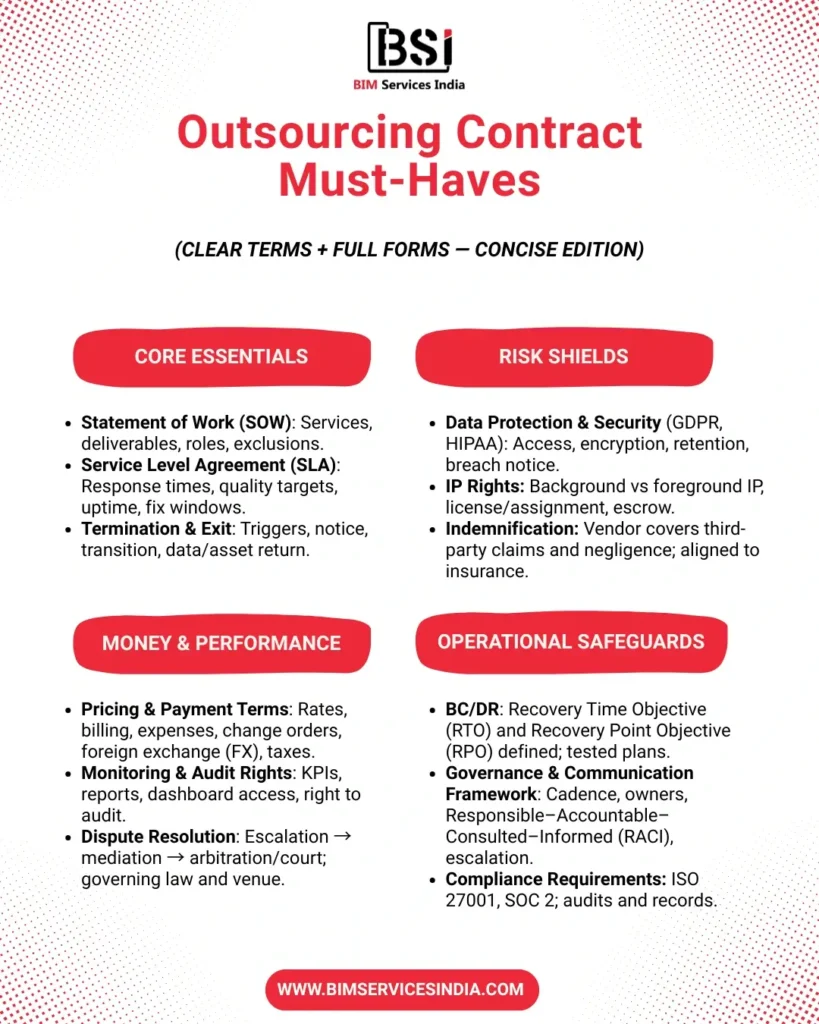
Outsourcing Contracts Must Haves
The Numbers Add Up
Depending on the project type and region, numbers may differ. But BIM outsourcing usually results in:
- 20-40% decrease in labour rates
- Reduction of several weeks in project turnaround
- Elimination of hiring, benefits, and training costs
- Better use of resources, allowing internal talent to work on high-value projects
Over time, these savings accumulate. The firm gains more profit, which can be invested in innovation and overall growth.
Quality BIM doesn’t have to break the bank!
Get high-accuracy LOD models delivered strictly within your budget.
Conclusion
Looking at the current and future trends, outsourcing seems non-negotiable. Creating a hybrid team is the winning formula with in-house teams focusing on design and client conversations whereas the outsourcing team creates scalable BIM models as per applicable standards. The challenges involved in outsourcing can be mitigated by a well-defined and structured project execution along with defined communication channels. Thus, by partnering with experienced BIM service providers like BIM Services India can support your business growth while keeping the costs in check.
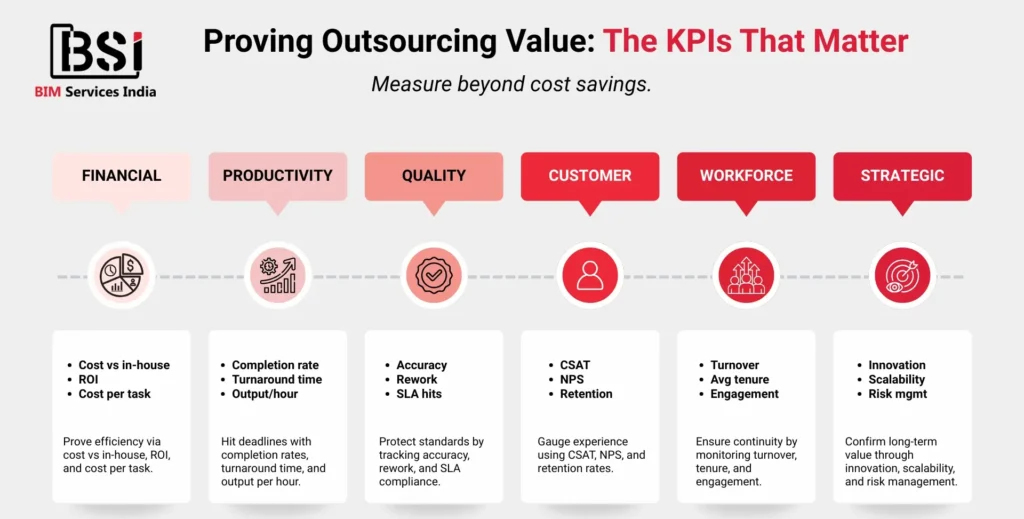
Outsourcing KPIs That Matter
Frequently Asked Questions
What is onboarding and integration, and how long does it take?
Integration is rapid but structured. First there is knowledge transfer: working standards, templates, details, and project protocols. Next comes a pilot project, where both teams refine communication and workflows. With collaboration tools, a proficient team becomes operational within 2 to 4 weeks. The idea is a partnership, not a vendor-ship.
When involving an external outsourcing partner, isn’t data security a big risk?
Data security is an essential consideration when the outsourcing partner is trustworthy. Numerous top companies have certifications like ISO 27001. The outsourcing partner provides you with encrypted data transfers, CDE access controls, watermarking, and physically secure files. They will also undergo your security vetting processes and sign NDAs. This provides greater security than IT setups in-house.
When projects vary in size, will outsourcing provide flexibility?
Indeed! The model is scalable. You can ask for a specific, finite task, increase the work to include production phases, or even maintain a dedicated team. This helps change resource commitments with a BIM partner to per-project basis, saving costs compared to full-time hires.
BIM outsourcing evolves with AI & automation: what does it mean for us?
Soon, BIM outsourcing partners will be using AI-driven tools for automatic clash detection, model checks, generative design, and also sheet creation, scheduling, and family updates. You can access cutting-edge technology through us, without any investments or training for the team. Your project will gain higher accuracy, faster outputs, and insights from data analytics.
