Risk Mitigation through Digital Information Management (DIM)
Table of Contents
Good Data Is No Longer Optional – it is needed in This Legally and Financially Exposed Construction Industry
In the architecture and construction industry, there has always been risk – commercial, contractual, or even operational. However, in recent years, the place where risk originates has changed – disputes, delays, and cost overruns today are not cause by physical construction failures, but by information failures. Missing records, differences in versions, unverified models, and undocumented decisions – all of this information failures sit at the heart of several legal and financial claims.
For BIM Managers, this shift within the BSI ecosystem is both a challenge and an opportunity. Digital Information Management (DIM) is not to be considered a back-office administrative function – with tasks like structuring folders, managing CDEs, and finalizing naming conventions. DIM is actually a risk control mechanism – it works as an insurance policy against errors, disputes, as well as liability.
In the coming years, firms that treat information as a commercial asset and a contractual necessity – not just a technical deliverable – will be able to protect themselves in this litigious, data-driven industry.
The Real Cost of ‘Bad Data’
Bad Data isn’t usually dramatic – it creeps up into the system quietly through processes like:
- Conflicting model versions which were issued to different stakeholders
- Missing files or some of them overwritten in shared environments
- No or unclear ownership of data and approvals
- Changes in drawings or specifications which cannot be traced
- Incomplete or even inconsistent information during handover
All of these might be minor in isolation, but collectively, they represent systematic exposure. Legally too, bad data undermines the project’s ability to show compliance, intent, and due diligence.
In terms of finance, bad data can increase the likelihood of rework, delayed claims, and professional indemnity. Many of the disputes that occur are not because of what was built – they are because of what information was relied upon, while the decisions were being made. In case of arbitration, the information quality matters more in showcasing your position – rather than the quality of your construction.
Did You Know?
A study by Autodesk and FMI has discovered that ‘bad data’ – that is, data which is inaccurate, incomplete, inconsistent, or untimely – may have resulted in about $1.8 trillion in losses globally in the year 2020. This was attributed to 14% of avoidable rework, which in itself was a cost of about $88 billion.
Information: A Legal Record, not a By-Product
Under certain official frameworks, like ISO 19650, information isn’t an informal by-product of your design and construction process – it is a managed asset with responsibilities of its own. Now, the CDE – Common Data Environment – isn’t only a collaborative platform, it is a system of record. For BIM Managers, this changes the information formats, such as:
- Every model or document which is issued is a potential contractual reference
- Each revision has to be traceable, authorised, and justified
- Every approval workflow becomes a part of the legal audit trail
This is important since the beginning of the project – weak information management systems mean that organization are unable to answer basic yet critical questions:
- Who issue this information – and when?
- Was this information suited for its stated purpose?
- Was this information superseded at the time that it was used?
- Who relied on this presented information – and under what assumptions?
Without clear answers for questions like these, liability is diffused – and thus, becomes dangerous.
Version Conflict: The Silent Risk Multiplier
One of the most common, and costly, failures of information in BIM based projects is version conflicts. Many versions of the same BIM model, while circulating across teams, can cause issues like:
- Construction occurring on superseded / older geometry
- Procurement of materials in incorrect quantities
- Misaligned assumptions of coordinates
- Conflicting instructions reaching the site
Legally speaking, this ambiguity creates grounds for a lot of post-project disputes. Some parties, stakeholders, or teams may think that they acted correctly earlier – based on the information available to them at that time. Since there was no single authoritative source of truth, it becomes difficult to assign fault – and makes it very easy to contest the information. A robust Digital Information Management (DIM) system can help us avoid this risk, by enforcing:
- Controlled status codes – such as WIP, shared, published, achieved
- Suitability definitions clearly stated with the use cases of different elements of the model
- Immutable historical records of the entire modeling process
This process is a containment of risk – not just some official bureaucracy.
Data Loss and the Myth of ‘We Can Recreate It’
value-of-data-in-construction
Yet another underestimated risk is data loss – which can occur due to a variety of reasons, such as platform migration, poor backups, or unmanaged rights for backup. Data once lost can never be fully recovered or reconstructed. Emails can go missing, decisions will lose context – thus, rationale disappears.
In situations where claims are to be made, this missing information is almost always interpreted unfavourably for the construction company. When the stakeholders cannot produce the required data, it can be seen as non-compliance of regulations – even when in reality, a good practice of maintaining data was followed. Proper Digital Information Management (DIM) frameworks can reduce this exposure by:
- Defining the retention policies which align with the contractual as well as statutory requirements
- Making sure that the information is stored in a structure, searchable environment
- Preserving the meta-data that explains why certain decisions were made – not just what was delivered
DIM actually protects the memory of the entire organization in a sense – which is an asset in itself, but it remains undervalued till it is gone.
Financial Risk: Poor Information Becomes Expensive
Weak information management can cause financial implications which extend beyond disputes. The poor quality of data directly leads to:
- Reworking caused due to incorrect or incomplete information
- Delays in the programme of the project due to clarification cycles
- Contingency allowances increased to balance out uncertainty
- Higher insurance premiums and other exclusions
An organization that undertakes a mature Digital Information Management (DIM) practice can benefit from it in the following ways:
- Faster decision making, based on data which is reliable
- Clearer scope and responsibility – with reduced ambiguity
- Greater confidence when undertaking commercial negotiations
- A stronger position in claims avoidance, as well as resolution
The investment in DIM is not an overhead for the company – it is cost optimisation which is adjusted for risk.
Did You Know?
Research states that more than half – about 52% – of all the construction rework done globally is actually caused by poor project data and miscommunication, which becomes a cause for substantial losses across projects.
Digital Information Management as an Insurance Policy
Effective information management reduces uncertainty – something similar to that of an insure policy. There are many ways in which a well-implemented DIM strategy can help the organization:
- It clarifies every user’s responsibility
- Reduces ambiguity of data
- Creates records which are defensible
- And enables accountability when necessary
As for the BIM Managers, this means that the narrative will now shift. DIM is not about enforcing standards just for the sake of it, or policing files – it is about protecting the organization legally, financially, and reputationally. The methods that can be undertaken by DIM can be:
- CDE Enforcement via standardized protocols
- Audit trails are automated & Metadata is rigorous
- Control of access & Information security
- Integration, not Silos
In a lot of ways, DIM – Digital Information Management – is the first line of defence before other parties, lawyers, or insurers get involved.
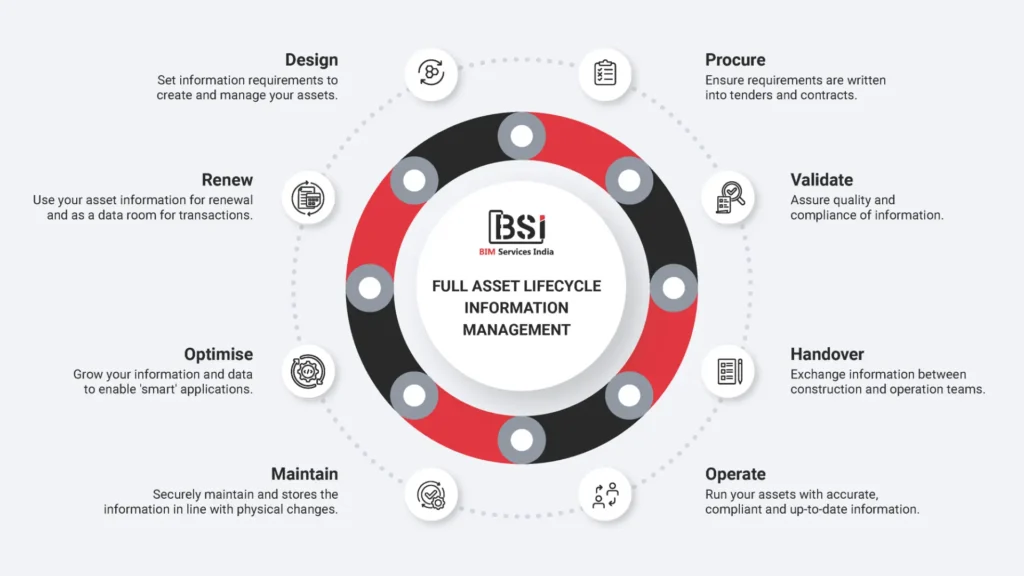
Full Asset Lifecycle Information Management
Read More
Real Benefits of Digital Twins for Facility Owners, FM Teams & Asset Managers.
The BIM Manager’s Evolving Role
As the industry grows and matures, the BIM Manager’s role will increase, intersecting with commercial, legal, and operational risk – something in the format of a ‘Chief Risk Mitigation Officer.’ This will require:
- A deeper understanding of the information requirements regarding the contract
- An alignment between the information protocols and real-world behaviours
- Active engagement with project leaders as much as the delivery teams
This transformation will help BIM Managers to advocate for thought leadership – letting the industry know why information management matters, not just how to do it.
Read More
Developing Custom BIM Execution Plans (BEPs) for Complex Projects.
Conclusion: Managing Information Is Managing Risk
Moving into the new year, the AEC industry’s leaders will be the ones who take the greatest risks not only in the physical construction process, but in the digital ecosystem that governs this construction. Concrete and steel structures are actually just manifestations of data – if this foundation of data is flawed, the entire project shall become vulnerable.
Did You Know?
Research states that about 30% project data in the industry is considered as ‘bad,’ leading to poor decision-making about half of the times – underlining that information quality issues exist extensively and impactfully in the built environment industry.
As a BIM Manager, your most important contribution to the project’s success will be to determine a strategic, rigorous Digital Information Management (DIM) program. This will help your team move from being liable for all problems, to providing solutions responsibly. The digital environment of the project will become a strategic shield – not just remain a cost centre. This transformation becomes an insurance for all your projects, profits, and importantly, professional integrity. In the field of AEC, this is the sign of indispensable leadership – good management at its core.
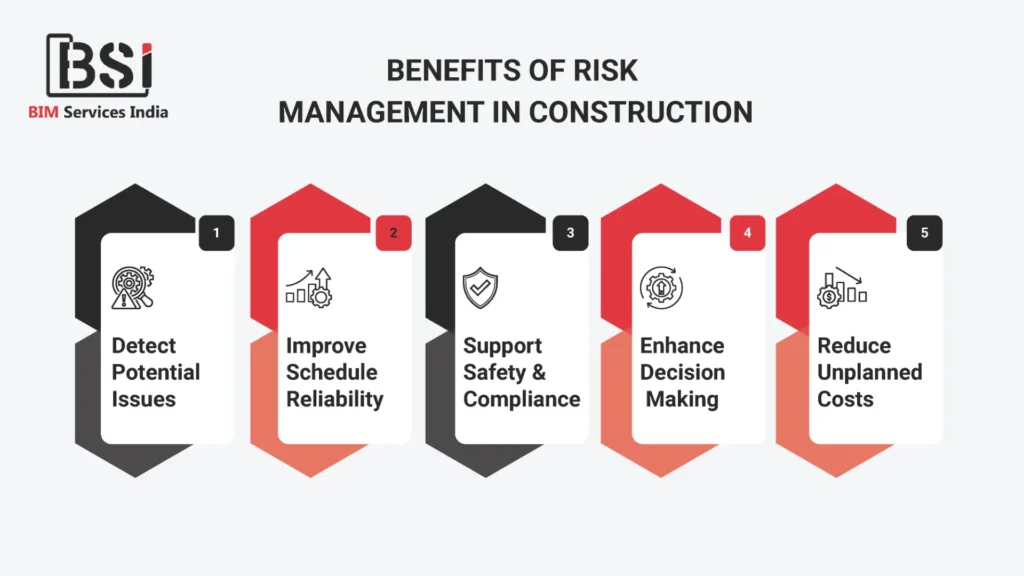
Benefits of Risk Management in Construction
Frequently Asked Questions (FAQs)
Stakeholders are focused on budget. How can I convince them to invest in a stronger DIM framework?
You can frame the investment as risk premium financing – not as an IT cost. Cite the avoidable costs to make a persuasive statement:
- Reduced Rework – you can calculate the average cost of a single field clash, caused by a document version error.
- Avoided Legal Fees – the reference industry can average out dispute resolution costs, even for settled claims.
- Efficiency Gains – teams can save the time they spend on searching for or verifying information.
You can present DIM as a cost-containment strategy – directly protecting the project’s contingency and the organization’s profit margin. Ask the client – what will be the cost of not having irrefutable evidence in a dispute?
As a BIM manager, how can I handle the resistance from veteran team members who rather prefer an informal method of data sharing, like emailing?
Show the formal DIM protocols as professional ‘liability protection’ for the veterans and their team. You can make an argument that email threads and local hard drives create personal liability silos. In case a dispute does arise, personal email IDs can become subject to legal discoveries. A centralised, managed system can protect the team members – it provides a clear, project-wide record of issuance and liabilities. The move for the entire organization is from ‘I have it on my computer’ to ‘the project record shows it’ – this shifts the liability from individuals to the project system as a whole.
In this risk-focused approach of DIM, can AI and Machine Learning play any role?
Of course, they can – emerging AI tools are developing into risk-mitigation assets now. They can:
- Automate Compliance Checking – scanning the incoming submissions and models against a standard library with defined protocols, which can help flag deviations even before they are shared.
- Detection of Anomaly – identifying the unusual patterns, for example a critical drawing is downloaded and modified outside of the CDE workflow.
- Predictive Risk Analysis – correlating the data silos, communication lags, and version conflicts – to predict what is at a higher risk of dispute.
The role of the BIM Manager will now evolve to curating and overseeing these intelligent systems – to use them and identify leaks, and plug them, from the information lifecycle.
After creating legacy projects with poor data hygiene over the years, how can we start to mitigate the ongoing risk, which is ‘bad data’?
You can start with something called ‘Legacy Data Risk Assessment.’ Take up projects which are within warranty, involved in ongoing litigation, or are subject to frequent audits – like public facilities. Instead of a full reorganization, you can create a ‘Defensibility Package’ – a consolidated archive of all final documents, communications, and models issued along with a verified hash/checksum to prove the integrity of the data. This contains the risks. As for future projects, you can implement the new DIM standards as soon as possible, using the previous risks as a case study to make protocols which are non-negotiable.
Don’t let “bad data” become a liability for your firm. Contact us today to implement a rigorous DIM program that turns your digital environment into a strategic shield!
