Digital Twins in 2026: Real Benefits for Facility Owners, FM Teams & Asset Managers
Table of Contents
Going into 2026, the discussions around Digital Twins is undergoing an important shift in the AEC ecosystem. The question now is – what value can the Digital Twin generate, quarter over quarter? Across the US, for facility owners, FM teams, and asset managers, Digital Twins are now a critical operational tool. With real-time monitoring, insights driven by AI, and subsequent predictive analytics, Digital Twins can transform BIM models from static physical assets into dynamic ecosystems that are rich in data and can continuously optimize themselves.
For AEC technology consultants who partner with BIM outsourcing partners, this shift is a powerful opportunity – now, clients can be guided to move beyond adoption mindset and think about the ongoing operational ROI. In this article, we talk about Digital Twins in 2026 – it is now not about adoption rates, but the measurable values that they provide.
From Data Visualization to Operational Intelligence
From Data Visualization to Operational Intelligence
Till date, Digital Twins were perceived as primarily advanced visualization platforms – replicas of buildings in a virtual format which were mostly used during the design and construction phases. However, in 2026, the core value of Digital twins has moved decisively in the operations happening post-construction.
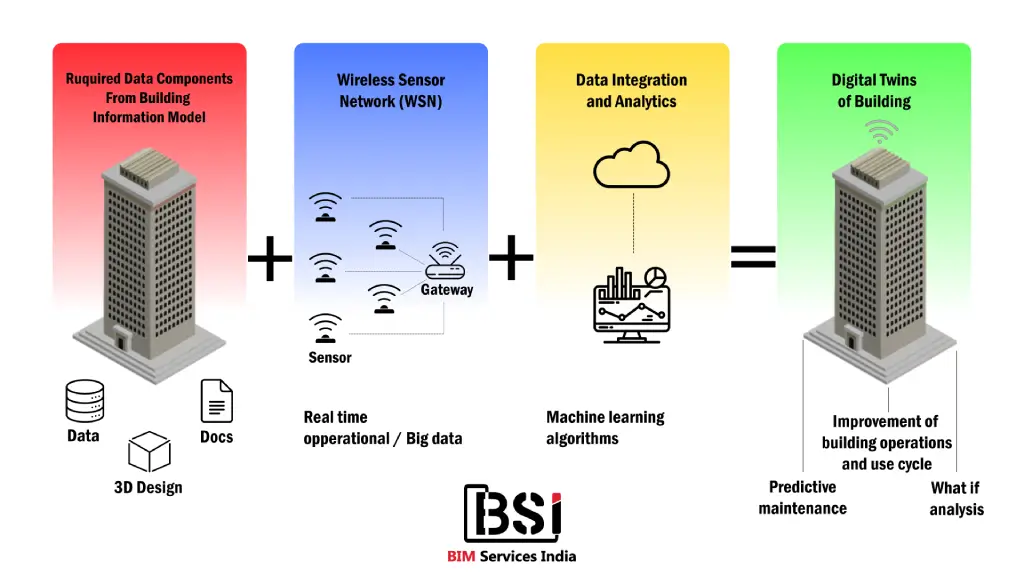
Digital Twins can receive data from IoT sensors, BMS systems, occupant behavior analytics, energy meters, as well as external environmental feeds – which are all funnelled into real-time platforms. These all can help teams make quick and informed decisions. AI and ML models are also capable of diagnosing issues and forecasting failures – for which they also recommend the lowest-cost operational path forward. Stakeholders cannot ignore these new, powerful ROI mechanisms.
The New Benchmark: Predictive Maintenance as a Profit Center
Maintenance strategies which are used traditionally rely on either periodic schedules or else reactive interventions – which are both inefficient. Digital Twins bring with them predictive maintenance – changing the equation entirely. BIM-driven Predictive Maintenance functions in real time in the following method:
- Devices integrated with IoT constantly track the asset health – energy load, vibration, temperature, and pressure, among other things.
- This data is mapped onto historical models, manufacturer guidelines, and operational thresholds via Digital Twins
- Algorithms with AI then predict the failures before they happen – recommending optimized maintenance schedules.
In 2026, this predictive maintenance process reduces the unexpected downtime and emergency repair costs that used to occur earlier. It also cuts down on the technician call-outs and the replacement frequency of parts or systems in the asset. Predictive maintenance can increase:
- The lifespan of the asset
- Productivity of the FM team
- Safety and compliance reliability.
The use of predictive analysis can justify the investment in a Digital Twin for larger campuses like hospitals, data centers, and manufacturing facilities. Asset managers no longer have to make guesses – hey can work on the insights provided by the new technology – which also quantifies in dollars saved, and the amount of downtime avoided for the asset.
Did You Know?
Digital Twins used in operations of a project can also reduce the downtime of the asset by approximately 20%, while increasing productivity through better data access and automation—SOURCE
AI Integration: The Cognitive FM Team Member
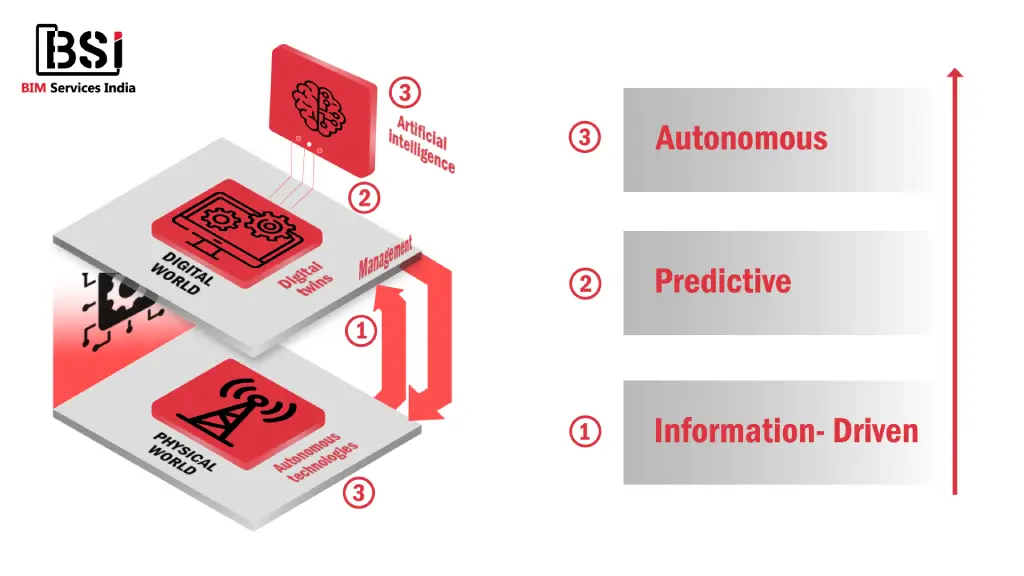
Digital Twins in 2026 will not just collect data – they will interpret it. The augmentation of AI-based FM operations includes the following:
- Automated fault detection and diagnostics (FDD): AI can flag anomalies, trace the root causes, and suggest corrective action for the same.
- Automation of work order: when the project / asset reaches a certain threshold of time or use, a maintenance task is triggered automatically.
- Self-learning energy optimization: AI can also analyse occupancy, energy tariffs, and HVAC performance to auto-adjust systems in real time.
- Scenario simulation to plan the asset lifecycle: FM teams can simulate the financial impacts of repairing assets, versus replacing.
Translating this into ROI
In 2026, AI-powered Digital Twins will shift the FM teams from manual monitoring to automated oversight. Rather than reacting to the issues, FM leaders can drive operational excellence with real-time dashboards which also directly correlate performance to cost.
Automation of this level is particularly valuable in the US, because:
- Increasing complexity of facility portfolios
- Maintenance labor of a skilled standard is expensive and often understaffed
- Requirements for sustainability reporting are rising
- Energy costs continue to fluctuate across different states
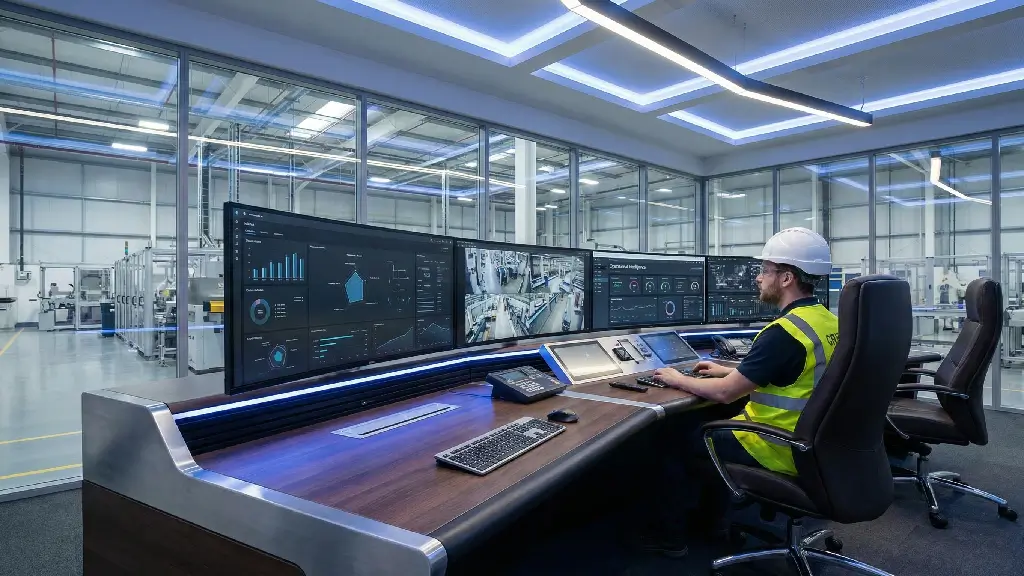
Digital Twins are becoming the operational control room – a place where data, automation, and decision-making converge.
Energy Efficiency & Real-Time Cost Optimization
States like California, New York, and Massachusetts are aggressively mandating carbon reduction targets and tightening of sustainability requirements – energy management has become top priority for every project. Digital Twins can actually contribute to this by:
- Constantly monitoring energy consumption of the building
- Identifying the inefficiencies in HVAC, lighting, and water systems
- Adjusting systems autonomously based on the real-time conditions
- Suggesting upgrades at a capital level with precise ROI calculations
In 2026, FM teams use Digital Twins to run analysis on ‘what-if’ situations: what if the HVAC load is reduced after 7pm? What if the density of occupation changes? What if we upgrade to energy efficient systems? This can empower the owners to make financial decisions based on data – not guesswork.
Digital Twins can be leveraged by Asset Managers for real-time cost reduction. They can be used to monitor entire building portfolios from a single interface. The biggest value is – operational cost visibility. Some examples of the real-time savings can be:
- Identifying the underperforming assets automatically – like air handlers which are running above load
- During peak-tariff hours, energy-intensive systems can be optimized
- Identifying assets nearing their end-of-life before they escalate into financial liabilities
- Through early diagnostics, reducing vendor dependency
- Using digital audit trails to manage warranties and maintenance contracts
Asset managers can instantly see the monthly OPEX, cost leaks, the anomalies in consumption, risk areas of the asset, and the opportunities for CAPEX optimization. This stage of real-time clarity, financially, did not exist five years ago.
Did You Know?
Firms that have adopted Digital Twins for optimizing building systems have reported up to 30% reductions in energy costs – by identifying the inefficiencies and enabling a dynamic control of systems like HVAC and lighting, among others—SOURCE
Positioning for 2026: The Strategic Imperative for AEC Firms
Converging Trends in BIM and Digital Twins
Three trends are converging in the field of BIM and Digital Twins:
- IoT sensors are getting cheaper
- AI models are being trained on vast FM datasets, and
- There is an improvement in the interoperability between BIM, BMS, CAFM, and ERP platforms.
Digital Twins have become more accessible and also more valuable than ever before. Now is the correct time to guide clients to move from static BIM models to fully operational, AI-enabled Digital Twins. Now, the firms that provide BIM outsourcing and Digital Twin enablement services are more important – a value creation engine. You firm’s value proposition can now focus on:
- Transitioning BIM models into operational Digital Twins
- Combining IoT and BMS data into a unified platform
- Setting up the predictive maintenance pipelines
- Curating asset information models for FM as well as lifecycle planning
- Providing dashboards and tailoring analytics to the owner KPIs
- Supporting the benchmarks for sustainability and energy consumption
AEC firms need to look at outsourcing partners who understand both BIM and operational intelligence – not just modeling. In 2026, Digital Twins will become an integral core of long-term client relationships – locking in for the asset’s entire lifecycle.
Summing Up – Digital Twin, An Indispensable Tool
In 2026, digital twin technology shall fully embrace its identity as an indispensable tool – for financial and operational workings of the built environment. For facility owners, asset managers, as well as FM teams, the benefits are concrete – predictive maintenance (protecting revenue), AI integration (elevating human roles), As‑built Scan to BIM models, and real-time analytics (meaning asset management is a strategic advantage).
According to Facilities Management Advisor (2025), the adoption of digital twins can reduce maintenance costs by 20 to 30% – while also extending the life of equipment by reducing reactive repairs.
The mandate is clear for the AEC industry. The future belongs to people who design, build, and deliver – not just physical spaces, but the data-rich, intelligent Digital Twin models – which will ensure resilience, efficiency, and profitability for years to come. To capture the undeniable returns of this technology, the question is no longer about understanding it – it is about implementing its strategy.
Digital Twins Reshape Asset Management
Frequently Asked Questions (FAQs)
Isn’t digital twin just a more complex BIM model – when there are already BIM model services, why should we opt for this?
A BIM model is a static combination of the design and construction data. A digital twin, on the other hand, is a dynamic, living system. Fed by real-time IoT data, the twin integrates with enterprise systems – like CMMS and IWMS – while employing AI for analysis and simulation. Consider the BIM model as a highly-detailed blueprint (an as-built) of the twin. This model is then evolved into an operational tool. Here, specialized BIM outsourcing partners become vital, ensuring that the initial model is built with richness, structure, and data fidelity required to power a future-ready twin.
When a digital twin integrates so many live data streams, how can we address data security and silo concerns?
By 2026, robust and vendor-agnostic data governance frameworks are going to be non-negotiable. Leading firms use a central data platform which has clear ownership protocols, role-based access controls, and two-end encryption. This means that the digital twin platform is for unified visualization and analysis – not necessarily storing all the raw data. AEC firms can design systems with ‘security by design’ principles – advising clients on governance structures that protect the operation data while allowing insight sharing across approved stakeholders – like FM, asset management, and sustainability.
When the FM team is not highly technical, will a digital twin overwhelm the client?
The modern digital twin interfaces are designed for usability – not complexity. In 2026, the FM team will not interact with the underlying 3D model – they will interact with dashboard alerts, prioritized work orders, and plain-language AI recommendations. The twin will answer the ‘what,’ ‘where,’ and the ‘what to do.’ Thus, the FM team shall spend less time diagnosing the problems and more time executing its strategic solutions. What is important for the benefit of the workflow is – change management and tailored training.
As an AEC firm, how can we start offering digital twin services – if it is an operational technology?
As a firm, your strategic entry point is as the creator and enabler of the original digital asset – while your expertise in designing and constructing the physical asset is beyond compare. You can position your services to deliver a ‘twin-ready deliverable’ – a BIM model which will be developed with the operational phases in mind. This will include processes like specifying IoT points, structuring data, and defining the initial performance benchmarks. You can partner up with specialised BIM outsourcing experts to handle the intensive data modeling. This way, you become the essential integrator who will bridge the capital delivery with lifelong operational value – meaning that you will remain in a prominent role throughout the asset’s entire lifecycle.
