Developing Custom BIM Execution Plans (BEPs) for Complex Projects
Table of Contents
Why One-Size-Fits-All BEPs Are Failing Complex Projects
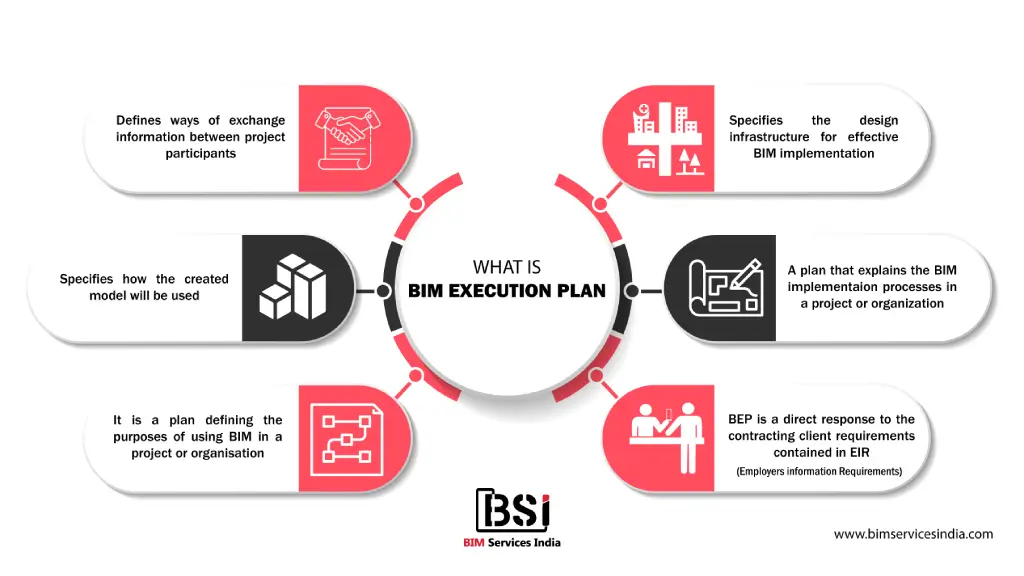
What is BEP – BIM Execution Plan?
In a complex construction project, a BIM Execution Plan (BEP) is meant to reduce risk, align stakeholders, and provide clarity across the project lifecycle – and the margin for error is razor-thin. In practice, however, many stakeholders still reply on generic, copy-pasted BEPs – plans recycled from past works, edited a little, and issued in haste to meet the contractual requirements. For a complex project – for example, a hospital – this approach is not just ineffective, it is dangerous.
A template document does not take into account situations like regulated environments, multi-disciplinary teams, advanced digital deliverables, and long operational lifecycles. If the BIM Execution Plan is not customized for important projects, there can be coordination failures, data loss, contractual disputes, and underperforming assets as a result – giving rise to misaligned expectations. We provide a strategic consultancy for customizing an actionable BEP according to your project’s unique challenges, stakeholders, and end goals – transforming BIM from a contractual obligation into a powerful tool for prediction, coordination, and data-driven delivery.
Complexity Changes Things – and Your BEP Must Reflect That
The complexity of a project is just not because of size – there is interdependency, risk, and information intensity involved at a complex scale. Some examples can include:
- Infrastructure projects which have multiple asset owners
- Healthcare facilities and hospitals with strict data governance
- Mixed-use developments integrating design, construction, FM, and digital twins
- Projects which require advanced data exchanges, automation, or regulatory compliance
Did You Know?
Studies show that the use of BIM can reduce project timelines by around 20%, and cut costs by approximately 15% – this occurs through early design error reduction and better coordination—The impact of BIM on project time and cost: insights from case studies
In environments like these, a generic BEP cannot answer questions critical to the project development, such as:
- What is the exact level of information which is required – by whom and when?
- Across the non-standard disciplines, how will coordination be managed?
- What data, and in what structure, must be present till handover?
- How will the obligations of the contract translate into actionable requirements for information?
Unless questions like these are addressed in the beginning, BIM can become a fragmented, reactive, and costly affair.
The Problem with Cookie-Cutter BEPs
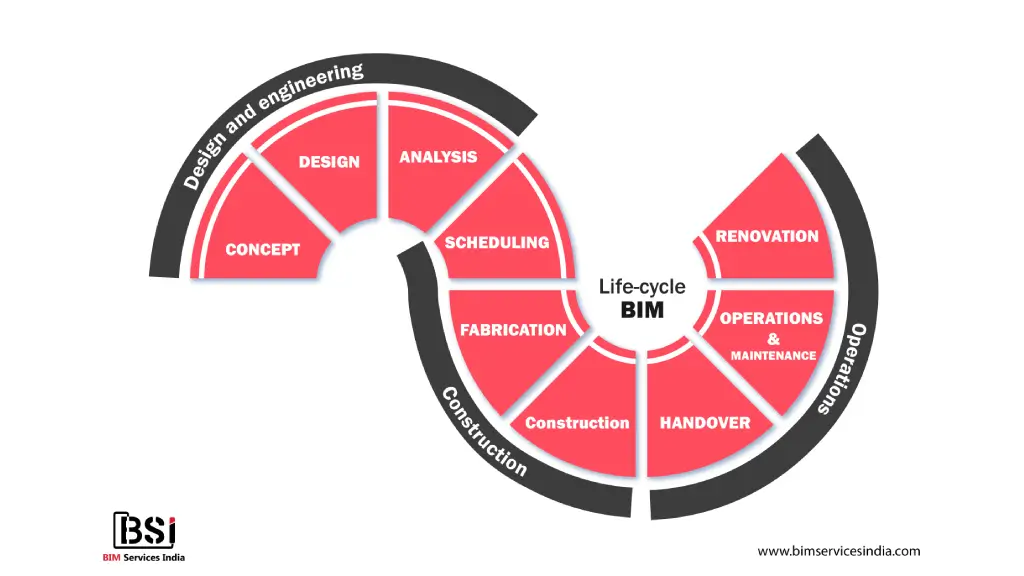
Building Information Modeling Lifecycle
Generic BEPs function on assumptions – and fail. A custom BEP can look compliant, but it can sow seeds of discoordination and rework. Most of the custom BEPs can fail in fundamental ways like:
1. LOD is Undefined or Misaligned
A generic BEP will reference LOD in broader terms or ranges (like LOD 300, 400) or ‘as required.’ Without clarifying the purpose of the model, the granularity of information, or the expectations of that discipline, LOD specifications can lead to over- or under-modeling (imbalanced use of resources), under-delivery, and even disputes over responsibility.
2. Ineffective Coordination Matrices
Copied coordination matrices do not reflect the true, complex, real-world interfaces – critical identification points aren’t marked, and there are sequencing issues or high-risk spatial conflicts. In an MEP-heavy project, there remain unresolved conflicts which are then cast away as ‘someone else’s problem.’
3. Data Exchange Requirements are Unclear
Many generic BEPs will treat data exchange as an afterthought. Primary data structures like file formats, naming conventions, and CDE workflows are documented, but information use cases are not – like handover, FM integration, compliance, and analytics. Lots of data remains unstructured and unusable.
4. Reactive Workflows, not Provocative
However, generic BEPs do not anticipate situations like unique project milestones, specialized contractor or subcontractor addition – or even the use of new and novel technologies such as reality capture or digital twins.
The result? BIM data looks complete, but it is quite unusable. A generic BEP can make the BIM data burdensome – turning the greatest asset into the greatest liability.
Did You Know?
Industry reports state that using BIM can lead up to an 80% reduction in design coordination issues and prove to have significant cost advantages, due to the rework which is avoided. Read more about—The Importance of BIM Coordination in Commercial AEC Projects.
Why do complex projects fail without a custom BEP?
Undertaking a complex BIM project without a custom BEP is as good as operating without a digital strategy. The points of failure can occur from reasons like:
- Design teams considering different assumptions of ‘completion.’
- Clash detection coming up with various irrelevant issues.
- Due to unclear information, reworking needed at a late stage in the project.
- Information of the asset which cannot be reused after handover or trusted.
- BIM Managers having to firefight without actually governing the project.
A custom BIM Execution Plan can address these issues even before they occur – strategic objectives can be translated into clear, enforceable digital rules for the project.
Our Approach: BEPs Designed for Your Project – Not Ours
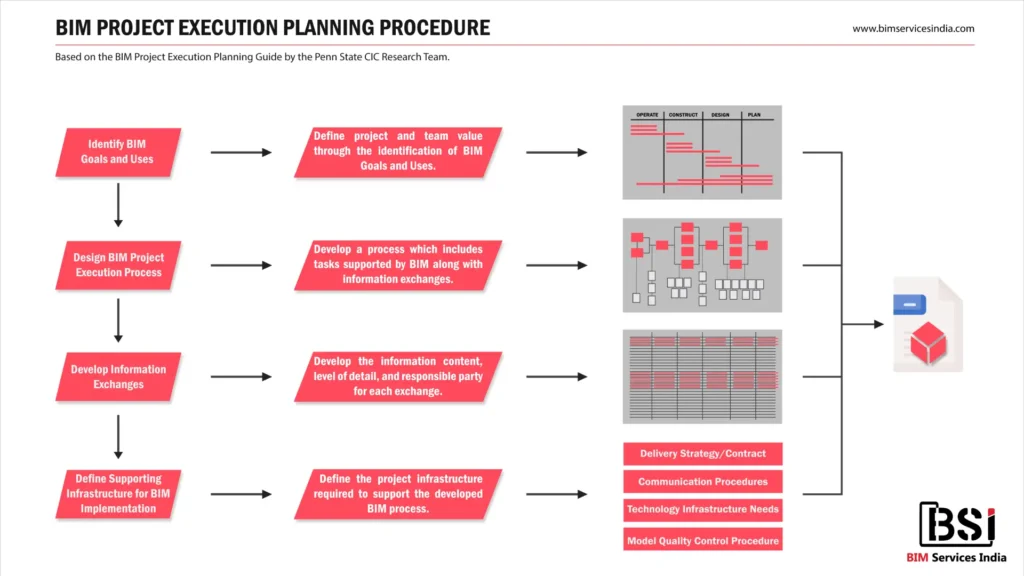
BIM Project Execution Planning Procedure
Our method of working is built on this principle – a BEP is a direct reflection of your project’s DNA – risk profile, delivery strategy, and information outcomes. The work starts not with a template, but a series of collaborative workshops – to understand your processes, commercial intent, technical delivery style, and operational value. These will then become the backbone of the project’s operations:
Defining LOD specifically for the project
Rather than relying on the basic 100-500 LOD scale and tables, we use the BEP to define:
- LOD on the basis of the purpose of the model, not just the stage of work
- Requirements specific to each discipline
- Data expectations in graphical as well as non-graphical formats
- Boundaries of responsibilities clearly drawn to avoid creeping of the different scopes of work
This decision ensures that the BIM team will model only what is actually needed – when it is needed – and to the right level of certainty, eliminating waste.
Tailored Coordination and Interface Matrices
Complex projects are bound to have complex teams – and our custom BEPs include dynamic coordination matrices that go beyond naming the responsible parties. They reflect:
- Pre-coordination requirements
- Actual spatial as well as data interfaces
- The high-risk coordination zones
- Interdependencies of different disciplines
- Clash detection tolerances and resolution protocols
- Sequencing the logic tied to construction and procurement
This transforms the coordination from being a reactive clash-finding exercise into a proactive risk management tool.
Defining the exchange of Data and Information flows
Data is the ultimate deliverable of a complex BIM project – these projects are successful or failures based on their information flow. Within your Common Data Environment (CDE), we create an information lifecycle, which defines:
- The structured data exchange points across the lifecycle of the project
- Required formats which align with downstream use – FM, analytics, and compliance
- Rules for validation, and responsibility checkpoints
- How the plan aligns with ISO 19650 workflows (government) and the CDE governance and rules (internal)
This process ensures that the data generated during the design and construction process is clean, compliant, structures, and directly usable for further use – such as commissioning, facility management, and handover.
Integrating new & unique Project Technologies & Processes
A custom BEP acknowledges new & unique elements of design and construction – like Lean construction (Last Planner), Power BI, and Digital Twins – weaving them into the core of the project. We can design the way BIM data will fuel the planning sessions, and how quantities from the model will sync with cost databases – similarly, how the as-constructed information model can be structured for Digital Twin. The BEP for your project will become the integrator of all digital project streams.
Building for BSI, Designing for the Future
Our BIM Execution Plans (BEPs) are aligned with BSI and ISO 19650 principles completely, and they go beyond compliance. We can focus on internal information management – making sure that every requirement exists for a reason, and delivers measurable value.
As the industry is moving forward:
- There will be a greater need for accountability for data of the asset(s).
- Integration with digital twins will increase.
- Contracts will rely more on the information which shall be delivered.
Thus, BEP is evolving from being a static document to a strategic instrument. This shift is reflected fully in our approach to creating BEPs.
Be a Though Leader: Move Beyond Templates
In the coming few years, the BIM Managers and leaders in our field will be not on their software proficiency – but on their ability to:
- Define the clear requirements for information
- Manage and mitigate digital risk
- Deliver the data that supports long-term performance of assets and complex projects
Template BEPs will not be able to meet these expectations – a custom BEP is the manifesto of this leadership. A custom BEP governs the project by foresight, precision, and collaboration. It is outcome-driven, and we can help organizations use custom BEPs to move from BIM adoption to BIM maturity – and BIM Managers to go from model coordinator to strategic information manager.
Did You Know?
Analyses of BIM use indicate that it provides an average ROI of ~350%, with some cases also exceeding 1000% ROI—SOURCE
Conclusion
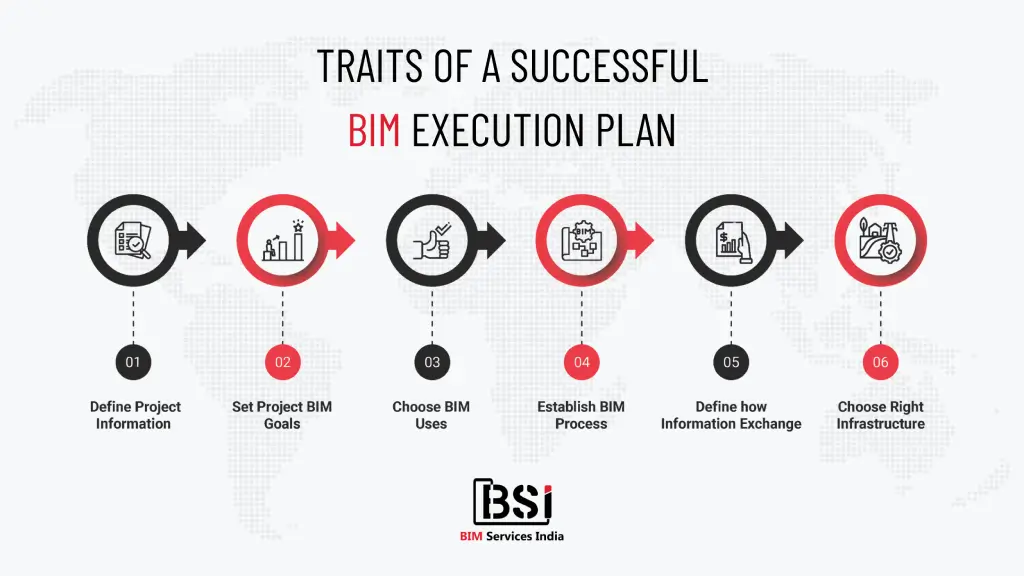
Traits of a successful BEP
For complex projects, there must be no shortcuts at any stage of working. A generic BIM Execution Plan (BEP), picked up as a template, is a shortcut – and this leads to ambiguity, conflict, and improper data production and storage. The answer is to invest in a custom BEP, designed in a sophisticated manner to match the complexity of the project.
If your project is complex and data-intensive, the question will no longer be ‘if’ you need a custom BEP – but it will be about who you should trust to define it correctly. We partner with forward thinking BIM Managers and project teams to build this alternative – custom BEPs which aren’t documents, but a strategic framework for success. These BEPs are built on top of a deep expertise of the industry, a rigorous understanding of standards, and a complete focus on the objectives of your project.
Frequently Asked Questions (FAQs)
How long does it take to develop a custom BEP – and when should we start the process?
A custom, robust BIM Execution Plan can take about 4 to 6 weeks of collaborative development – but the timelines vary based on the scale of the project as well as stakeholder availability. The primary focus is to start as early as possible. The BEP is a project-enabling document – it should not turn into a post-contract audit document. The ideal time to start? During the tender or early appointment phase – this way, the BEP will be able to govern the entire design and delivery process from day one. Investing this time in the beginning will prevent exponential costs occurred due to rework later.
Is it true that a detailed, custom BEP can become too rigid, stifling innovations and collaboration?
Absolutely not! In fact, a generic BEP might be rigid – since it is a one-size-fits-all plan. A custom BEP, however, is designed for your team, and your processes. By defining the roles, expectations, and protocols upfront, a custom BEP removes ambiguity – which is the true killer of collaborative working. This creates a stable, predictable framework within which the teams can operate and innovate confidently -because they know how the work will be integrated, and what information they will receive from others. By defining the rules of engagement, it enables collaboration in the team.
As a BIM Manager, how will I be involved in the development process?
You, as the BIM Manager, are our essential partner. We will be the facilitators and experts of BEP architecture – you are the expert of the project team’s members, culture, and other dynamics & challenges. Our process and methodology include a series of structured workshops and interviews with you – and other key stakeholders of the project. Your involvement from the beginning will ensure that the final document is not only technically sound, but also practical, implementable, and importantly, championed by you. We shall equip you with the plan and the buy-in to reference it.
What can be the tangible ROI of investing in a custom BEP, versus using a free template?
The major return on investment comes through risk reduction and cost avoidance:
- Reduced rework and clashes – ambiguous modeling is prevented by precise LOD and coordination matrices, cutting down the countless hours of rework and last-minute resolution.
- Efficient data handover – eliminating the costly, massive effort of data mining and cleansing at handover, structured data exchanges can help deliver immediate value to the operator.
- Lesser RFIs and change orders – clear protocols and defined information exchanges can minimize ambiguities and surprises in the field.
- Enhanced reputation – when you deliver a project on time with a clean, usable digital twin, your team gets established in the market as a leader, winning more work in the future.
Investing in a custom BEP gives far better ROI when compared to the cost of even one single major coordination failure or some data deliverable rejection on a complex project.
Did You Know?
A cookie-cutter BEP will become the weakest link in your multi-million-dollar project – do not let that happen. Talk to us today to understand how a custom BEP can meet requirements, define a new standard for excellence, and help you reach your ambition.
